
Most engineers can quote typical pipe roughness values from memory. For clean water pipelines, a PVC pipe may be assigned a roughness of around 0.0015 mm when new, polyethylene perhaps 0.03 mm after being in use for some time, while cement-lined ductile iron may be assigned a somewhat higher value. These values are then used within the Colebrook-White or Swamee-Jain equations to calculate friction losses and develop system curves. For clean water systems, this approach is generally appropriate. For sewage rising mains, however, the situation is quite different.
A major study undertaken by HR Wallingford in 2004, titled Flow Resistance of Wastewater Pumping Mains, found that the apparent hydraulic roughness experienced by flowing wastewater is influenced far more by operating velocity and wastewater conditions than by the pipe material itself. The findings of that study subsequently influenced both Design of Pipes, Sewers and Channels (8th Edition) and the WSA-04 Sewage Pumping Station Code of Australia. This has important implications for the design and assessment of sewage pumping stations and rising mains.
The traditional approach
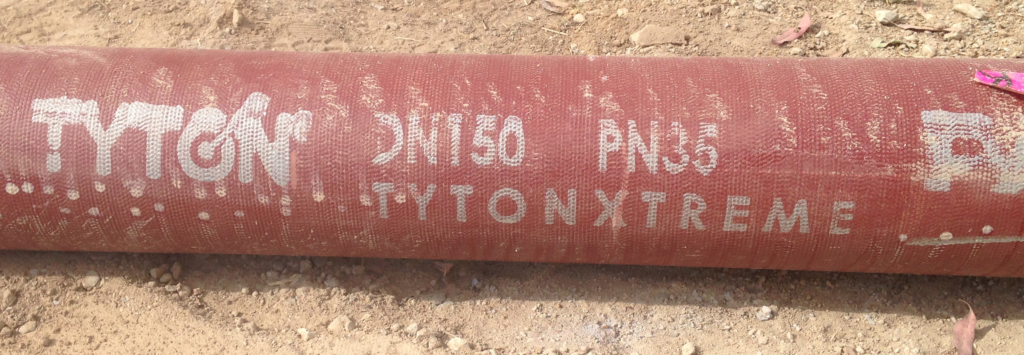
Most hydraulic models are developed using a fixed pipe roughness value based on pipe material. For example, a designer may assume that a new PVC rising main has a lower roughness than a ductile iron rising main and therefore lower friction losses. In clean water systems, this is generally true because the hydraulic roughness is dominated by the physical condition of the pipe wall.
Wastewater systems behave differently. Over time, biological slime layers, grease deposits and other materials accumulate on the internal surface of the pipe. These deposits influence the hydraulic behaviour of the system and can become more significant than the actual pipe wall material itself. The result is that the apparent or “pseudo roughness” experienced by flowing wastewater may be substantially different from the intrinsic roughness of the pipe material.
The HR Wallingford study
The HR Wallingford research involved field testing of operational wastewater pumping mains across a wide range of pipe sizes, materials and operating conditions. The study incorporated data from more than twenty sites and included pipe materials such as:
- uPVC
- polyethylene
- ductile iron
- cast iron
- steel
- asbestos cement
- concrete
Pipe diameters ranged from approximately 75 mm to 1000 mm and operating velocities covered a wide range of practical wastewater pumping conditions.
For each site, hydraulic roughness values were back-calculated from measured field performance using the Colebrook-White equation. The resulting roughness values therefore represented the overall effect of pipe wall condition, biological slime growth, grease deposits and any reduction in effective pipe diameter. Rather than relying on theoretical assumptions, the study was based on the performance of actual wastewater pumping mains operating in service.
Velocity is the dominant factor
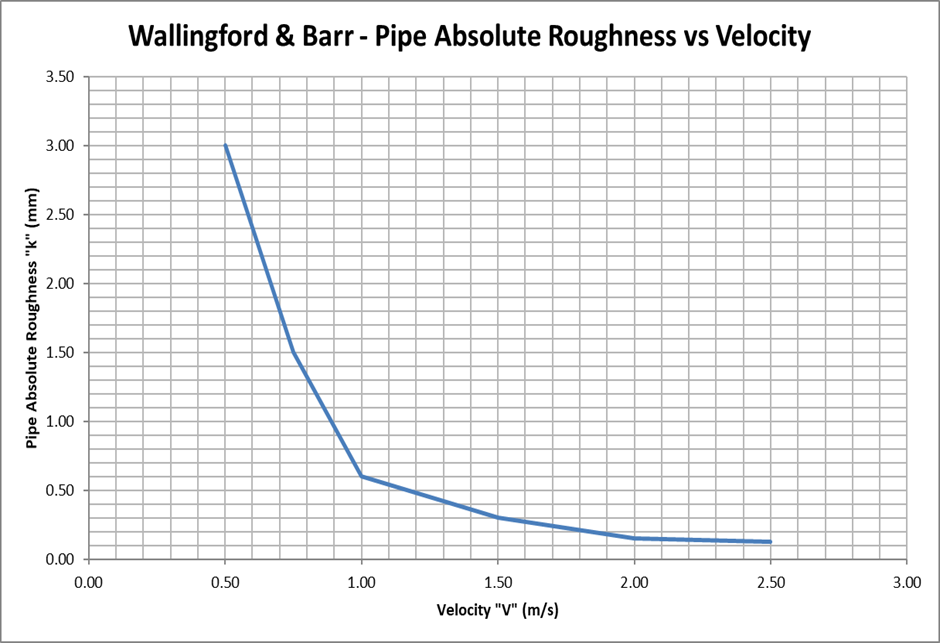
One of the most significant findings of the study was that hydraulic roughness decreases as flow velocity increases. Figure 2 shows the relationship developed by Wallingford and Barr between flow velocity and equivalent hydraulic roughness.
The trend is striking…
- At a velocity of approximately 0.5 m/s, the equivalent hydraulic roughness is around 3.0 mm.
- At a velocity of approximately 1.0 m/s, the equivalent hydraulic roughness reduces to around 0.6 mm.
- At a velocity of approximately 2.0 m/s, the equivalent hydraulic roughness reduces further to around 0.15 mm.
In practical terms, the apparent roughness of a wastewater pumping main may reduce by a factor of twenty or more as operating velocity increases. This finding explains why the long-standing wastewater industry recommendation of maintaining minimum velocities around 1.0 m/s remains important. Higher velocities not only assist with solids transport and minimise sediment deposition, but also reduce the apparent hydraulic resistance of the rising main.
What about pipe material?
The researchers specifically investigated whether pipe material had a significant influence on hydraulic roughness. Perhaps surprisingly, the study found no clear overall relationship. Although some scatter was evident in the data, the influence of pipe material was relatively small when compared with the influence of velocity and the variability introduced by slime growth and wastewater characteristics. The report concluded that there was no clear justification for assigning different wastewater roughness values based solely on pipe material. This is a very different conclusion from the approach commonly adopted for clean water systems.
For wastewater applications, a PVC rising main operating at low velocity may exhibit a higher effective roughness than a ductile iron rising main operating at higher velocity. The operating conditions become more important than the pipe wall itself.
Why this matters
The choice of roughness value directly affects the shape of a system curve. Small changes in assumed roughness can produce significant changes in predicted friction losses, particularly for long rising mains. Figure 3 shows an example of sewage pumping station system curves developed using Wallingford and Barr pseudo roughness values.
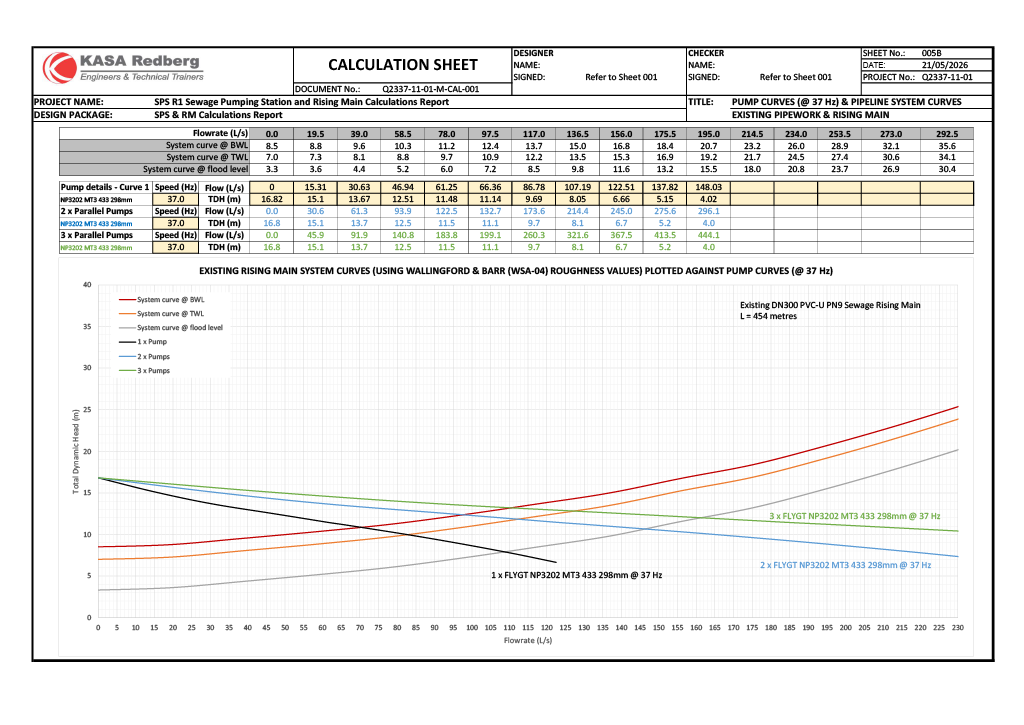
Figure 3 – Example sewage pumping station system curves developed using Wallingford and Barr pseudo roughness values
Changes in the assumed roughness value can influence:
- Predicted pump duty point
- Pump efficiency
- Energy consumption
- Assessment of spare system capacity
- Pump selection
- Rising main upgrade decisions
Consequently, roughness selection is not merely an academic exercise. It can materially affect the outcome of a design.
Adoption into industry practice
The significance of the HR Wallingford work is demonstrated by its adoption into recognised design references. The findings were incorporated into:
- Design of Pipes, Sewers and Channels, 8th Edition
- WSA-04 Sewage Pumping Station Code of Australia
Today, the Wallingford and Barr methodology is widely used throughout the Australian water industry when assessing sewage pumping station and rising main performance. For many engineers, the roughness-versus-velocity relationship has become standard practice, even if they are unaware of the original research from which it was derived.
Practical implications for designers
When assessing sewage rising mains, it is worth remembering that wastewater pipelines are not simply clean water pipelines carrying dirty water. Their hydraulic behaviour is influenced by:
- Biological slime growth
- Grease accumulation
- Solids transport
- Flow velocity
- Wastewater characteristics
For this reason, assigning roughness solely on the basis of pipe material may not provide a realistic representation of system performance. Where wastewater-specific guidance is available, designers should consider adopting pseudo roughness values derived from recognised wastewater research rather than relying exclusively on traditional material-based roughness values.
Final thoughts
When modelling clean water systems, pipe material remains an important determinant of hydraulic roughness. For wastewater pumping mains, however, field research has demonstrated that the situation is more complex.
The HR Wallingford study showed that operating velocity is the dominant factor influencing pseudo roughness and that pipe material has no clear overall effect on the resulting hydraulic resistance.
More than twenty years after the report was published, the findings continue to influence the design of sewage pumping stations and rising mains throughout Australia and many other parts of the world.
Sometimes the most important parameter in a hydraulic model is not the pipe itself, but the way in which it is operated.
References
- Forty, E.J., Lauchlan, C. and May, R.W.P. (2004), Flow Resistance of Wastewater Pumping Mains, Report SR641, HR Wallingford.
- Wallingford, H.R. and Barr, D.I.H. (2006), Design of Pipes, Sewers and Channels, 8th Edition, Thomas Telford, London.
- Water Services Association of Australia (WSAA), WSA-04 Sewage Pumping Station Code of Australia (current edition).