
If you want to start a lively discussion among hydraulic engineers, irrigation designers and water network modellers, simply ask: “Which head loss method should we use?”
For more than a century, two methods have dominated water pipeline design:
- Hazen-Williams (H-W) – the empirical workhorse of municipal water and irrigation systems.
- Darcy-Weisbach (D-W) – the physically based equation taught in fluid mechanics and used throughout the process industries.
Modern software such as EPANET, WaterGEMS, FluidFlow3, KYPipe and AFT Fathom can solve complex networks in milliseconds, so computational effort is no longer the issue. In other words, the decision is no longer driven by computational limitations but by engineering philosophy and the requirements of the application.
The real question is which methodology is most appropriate for the problem at hand?
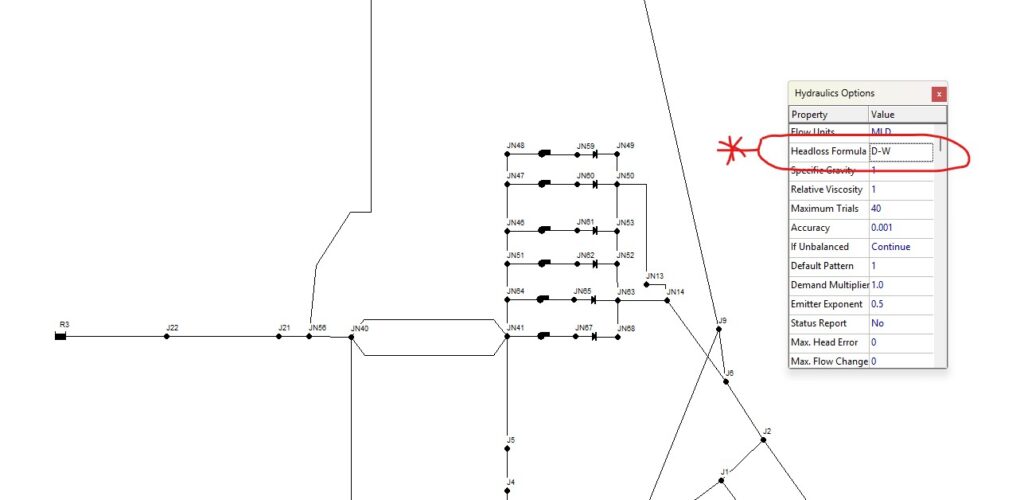
Fig. 1 EPANET hydraulic options dialogue box – Darcy-Weisbach method selected
The Case for Hazen-Williams (The Pragmatist’s Choice)
There is a reason Hazen-Williams has survived for more than 100 years.
1. Legacy data matters: Many water utilities have decades of network models, field test data and design standards built around Hazen-Williams C-factors. Converting everything to equivalent roughness values would be a significant exercise with little practical benefit.
2. Real-world uncertainty often dominates: The internal condition of a buried main is usually unknown. Tuberculation, biofilm growth, partially closed valves and undocumented modifications often introduce more uncertainty than the mathematical differences between head loss equations.
3. It works extremely well in its comfort zone: Most potable water systems operate:
- with water at ordinary temperatures;
- in fully turbulent flow;
- at velocities of around 0.5–2.0 m/s.
Under these conditions, Hazen-Williams usually produces very good engineering results with minimal effort. That is precisely why many utilities continue to use it today despite the availability of more physically rigorous alternatives. The “Australian Pipe Friction Handbook”, published by Pump Industry Australia, still quotes C-factors in its head loss tables.

Fig. 2 Tuberculation in an Australian cast iron water main (installed in 1926)
The Case for Darcy-Weisbach – One Methodology for Everything
Darcy-Weisbach is fundamentally different. Rather than being an empirical curve fit for water, it is based on fluid mechanics and applies to virtually any fluid and any pipe material. Its advantages become apparent once we move outside conventional water distribution systems.
1. Friction responds to actual flow conditions: In turbulent flow, the Darcy friction factor depends on both Reynolds number and relative roughness. Consequently, it automatically accounts for changes in viscosity, pipe diameter and flow regime.
2. Temperature matters: Cold water is more viscous than warm water. Darcy-Weisbach captures this indirectly through its dependence on Reynolds number (and therefore, fluid viscosity). Hazen-Williams has no temperature term and therefore cannot respond to seasonal changes in fluid properties.
3. Sewage rising mains prove that roughness isn’t constant: One of the best examples comes from sewage rising mains. Research by HR Wallingford showed that biological slime growth depends heavily on operating velocity. At low velocities, thicker biofilms develop. At higher velocities, wall shear strips the slime away.
Consequently, WSAA’s Sewage Pumping Station Code of Australia, WSA-04, does not simply assign roughness based on pipe material. Instead, the recommended Darcy-Weisbach roughness is related to operating velocity.
The hydraulic roughness of a sewer is therefore an operational characteristic, not merely a material property.
What do I use?
For conventional water distribution systems, both methods work well. But my work also involves sewage rising mains, slurry pipelines, chemicals, compressed air, steam systems, fuel gases and non-Newtonian fluids such as tailings and paste slurries. I prefer a methodology that can be applied consistently across all of these applications.
Darcy-Weisbach provides that framework. It forms the basis of:
- water system calculations
- sewage pipeline modelling
- non-Newtonian friction methods
- and most compressible flow pressure drop calculations.
Rather than remembering one equation for water, another for slurries and another for gases, I find it easier to work from a single fundamental methodology and then apply the appropriate friction factor relationships.
For me, Darcy-Weisbach provides a common framework that works whether I am analysing a sewage rising main, a tailings pipeline or a compressed air system. One methodology, appropriately applied, keeps life much simpler.

Final Thought
Hazen-Williams isn’t wrong. It’s an elegant empirical shortcut that works exceptionally well within its intended application. But if your work extends beyond clean water at ordinary temperatures, Darcy-Weisbach becomes difficult to avoid.
So, which camp are you in? Team Hazen-Williams or Team Darcy-Weisbach?